ADAPTIVE RIVER PROGRAM
The Adaptive River Program is a supported, multi-day river experience for people living with spinal cord injury and other physical disabilities.
Adaptive equipment, experienced guides, and individualized planning create opportunities for meaningful challenge, belonging, and connection.
A Decade of Adaptive Rafting Innovation
More than a decade ago, LEAP began working with Johnny Kurtz of Rogue Gear Works, alongside experienced whitewater supporters and testers, to explore what adaptive access to whitewater could look like. There was no perfect blueprint. The work evolved through ideas, testing, trial and error, and repeated refinement on the river. Over four generations of adaptive raft design, that collaboration helped shape the equipment and approach LEAP uses today.
In 2025, with support from a Waterway Access Grant from the Oregon State Marine Board, LEAP launched its Adaptive River Program pilot on Oregon’s Lower Deschutes River and expanded the program in 2026. The pilot was designed to explore what it takes to offer a meaningful, multi-day river experience for people living with spinal cord injury and other physical disabilities, while thoughtfully managing risk and gathering the information needed to guide future program growth.
Across three adaptive programs, LEAP welcomed 13 participants and deployed two specialized adaptive catarafts with secure wheelchair-mounting systems. Participants navigated whitewater, camped beside the river, shared meals and stories, and helped shape what the program could become.
The pilot reinforced something important: adaptive access is about far more than equipment. It requires individualized preparation, appropriate staffing, thoughtful planning for transfers and personal care, accessible transportation, flexible camping systems, and honest communication about the realities of a wilderness environment.
Most importantly, we learned that people with lived experience must remain central to every stage of program design. Participant and advisor feedback continues to guide LEAP’s equipment, training, safety procedures, support systems, and plans for the program’s next phase.
How Adaptive Access Works
LEAP’s adaptive catarafts are designed to support participants who use wheelchairs in navigating multi-day whitewater river experiences. Each cataraft includes a specialized frame and secure wheelchair-mounting system that allows a participant to remain in their own chair while on the river. Sand tires and other adaptive equipment help the team move across beaches, riverbanks, and uneven campsite terrain.
The equipment is only one part of making the experience accessible. Before each program, LEAP works individually with participants to understand their mobility, transfer preferences, personal-care needs, medications, communication, comfort, and goals. Together, we develop a plan for boat seating, transfers, camping, bathroom access, transportation, and the type of assistance that may be needed.
On the river, experienced guides manage the catarafts, whitewater, equipment, and overall safety. Additional trained staff and support people provide individualized assistance based on the collaboratively developed plan.
Every participant is the expert on their own body. LEAP’s role is to listen, plan carefully, adapt creatively, and provide honest information so each person can make informed choices about their experience.
“I had the incredible benefit of hearing the river described from the perspective of someone I deeply value. The sound of the water, the temperature dropping as you approach a rapid, the anticipation and fear of knowing you are about to enter something that will push you beyond where you may believe you can go.
That visualization conversation reminded me that this is what the river gives us. It creates a rare space where we get to feel things fully: fear, awe, vulnerability, courage, joy, and where we can discover something about ourselves that is much harder to access in everyday life.
I believe deeply that we should do everything we can to bring people who have had the least access, and perhaps the least reason to believe that this kind of experience could ever belong to them, to places that make their hearts full.
Because something changes when you are standing at the edge of what you thought was possible and realize you can keep going. The adversity you carry does not disappear. But maybe it begins to take up a different amount of space. It becomes something that travels with you, rather than something that determines where you are allowed to go.”
— Amy Wickstrom, Executive Director, LEAP
-
The program is designed for individuals living with spinal cord injuries and other physicial disabilities. No previous rafting or camping experience is required.
Because each person’s abilities, goals, health considerations, and support needs are different, participation is determined through an individualized planning process, not by diagnosis alone. LEAP works with each prospective participant to understand what support would be needed and whether the program, environment, equipment, and available staffing can provide a safe and meaningful experience.
-
Before the program, LEAP meets individually with each prospective participant to discuss mobility, transfers, personal care, medications, communication, camping experience, medical considerations, and the type of assistance they may need.
This process is collaborative and is intended to support informed choice. Participants must be able to communicate their needs honestly, participate in preparation, follow river-safety instructions, and work with LEAP to develop an appropriate support plan.
Participation is confirmed only after LEAP and the prospective participant agree that the program can reasonably support their needs.
-
LEAP currently operates two specialized adaptive catarafts with secure wheelchair-mounting systems. Additional equipment includes sand tires and other tools designed to assist with movement across uneven riverbanks and campsites.
Transfer methods are determined individually and practiced or discussed in advance whenever possible. LEAP does not use one standard transfer method for everyone. Participants help guide decisions about their bodies, equipment, comfort, and preferred assistance.
Equipment can improve access, but it cannot eliminate every barrier present in a remote river environment. LEAP will discuss anticipated limitations openly during the planning process.
-
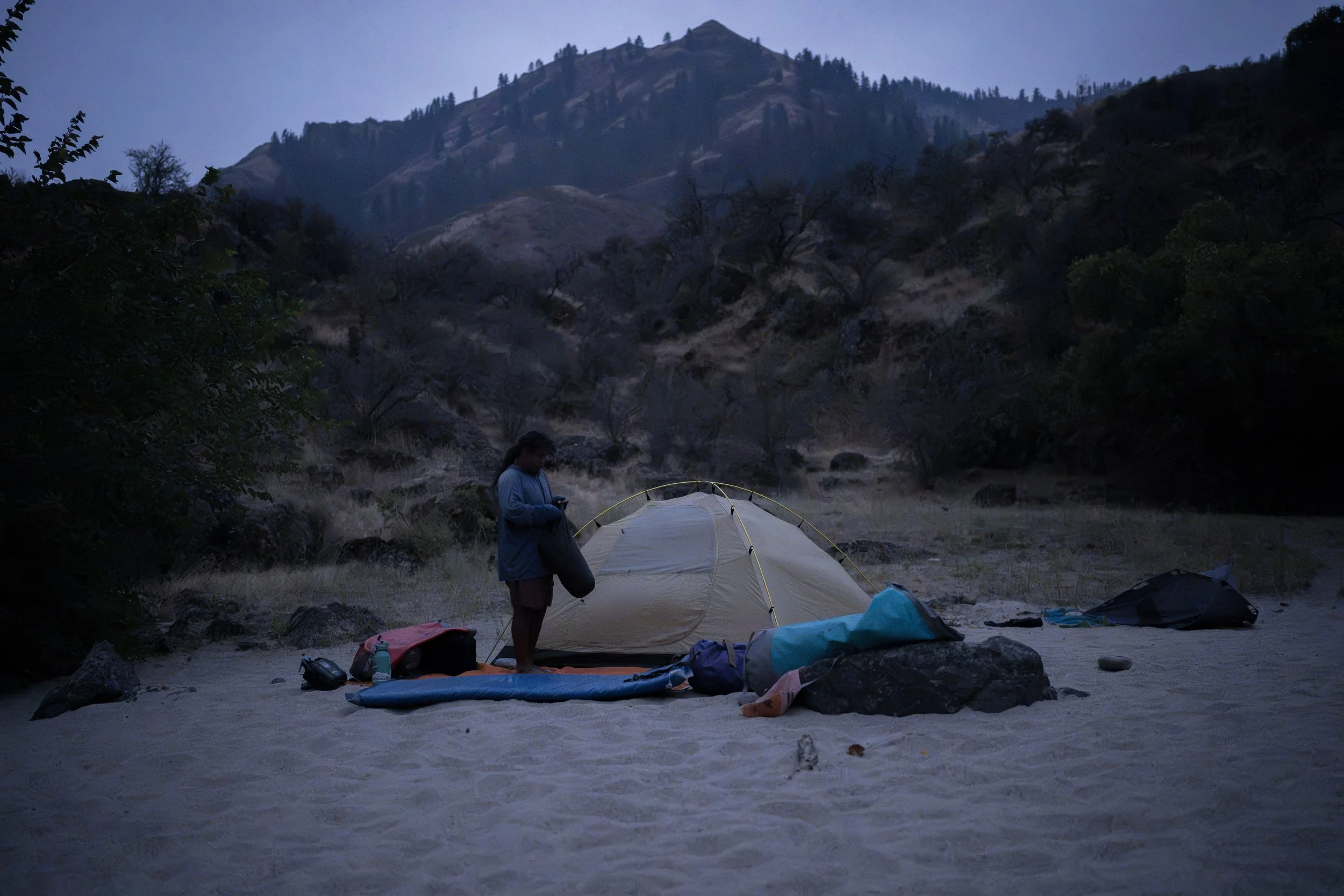
Adaptive programs include primitive riverside camping. Campsites may have sand, rocks, uneven terrain, limited pathways, and no permanent accessibility infrastructure.
LEAP carries a portable river toilet and works with participants in advance to plan bathroom access, sleeping arrangements, transfers, hygiene, medications, and other personal-care needs. Participants should expect conditions to be different from an accessible campground or indoor facility.
LEAP river guides do not automatically provide clinical or ongoing personal-care services. If a participant needs assistance beyond what LEAP’s trained team can appropriately provide, a caregiver or support person may need to attend.
-
River and wilderness programs involve inherent risks that cannot be completely eliminated. LEAP uses experienced river professionals, participant-specific planning, appropriate safety equipment, established emergency procedures, and trained support staff to manage those risks responsibly.
Before launch, LEAP reviews relevant health information, medications, emergency contacts, evacuation considerations, and participant-support needs. The Head Guide retains final authority over river safety, boat assignments, route decisions, and emergency response.
River camps are remote, and emergency medical care may not be immediately available. Weather, water levels, wildfire, air quality, and participant or staffing needs may require LEAP to modify, postpone, or cancel a program.
-
Some participants may benefit from, or require, a caregiver, friend, family member, or other support person to attend. This decision is made collaboratively based on personal-care needs, transfers, communication, medications, nighttime support, behavioral or emotional needs, and LEAP’s available staffing.
Support people participate as members of the river community and must complete LEAP’s forms, preparation, and safety requirements. Because program and permit capacity is limited, the inclusion of a support person must be confirmed in advance.
LEAP welcomes participants to help define what meaningful, respectful support looks like for them.
-
LEAP programs are offered to participants without a program fee. LEAP provides group river equipment, camping equipment, meals during the program, professional guides, adaptive equipment, and program facilitation.
Transportation arrangements and meeting locations vary by program and will be explained before participation is confirmed. Participants may be responsible for reaching a designated meeting location, although LEAP will work with participants and partners to identify transportation barriers and possible solutions.
-
Do I need previous rafting or camping experience?
No. Previous river and camping experience is not required. LEAP provides preparation, equipment, instruction, and support.Will I remain in my wheelchair on the river?
Some participants use a securely mounted wheelchair on an adaptive cataraft. Others may use a different seating or boat configuration. The appropriate setup is determined individually.Can LEAP accommodate every disability or medical condition?
Not necessarily. LEAP considers each person individually based on their abilities, health considerations, equipment needs, personal-support requirements, and the conditions of the specific program.Can I bring a caregiver or support person?
Yes, when LEAP and the participant determine that a support person is appropriate and space is available. This must be arranged before the program.What are the sleeping conditions?
Participants sleep in tents at primitive riverside camps. LEAP works individually with participants to identify suitable tents, sleeping systems, transfer plans, and equipment needs.What are the bathroom facilities like?
LEAP carries a portable river toilet. There are generally no fully permanent accessible bathrooms at wilderness campsites, so bathroom and personal-care plans are developed before the trip.Will I need to share medical or personal information?
LEAP asks only for information necessary to understand your support needs, plan accommodations, manage medications appropriately, and respond in an emergency. Information is treated confidentially.Is the program completely accessible?
No wilderness river environment is completely accessible. LEAP uses adaptive equipment, individualized planning, trained staff, and creative problem-solving to reduce barriers while being transparent about the conditions that remain.How do I know whether the program is right for me?
Submit an interest form or contact LEAP. A member of the program team will speak with you about the experience, your goals, and the support you may need. Expressing interest does not obligate you to participate or guarantee placement.